

Microneedling Side Effects, Aftercare, and What to Expect Before, During, and After Treatment
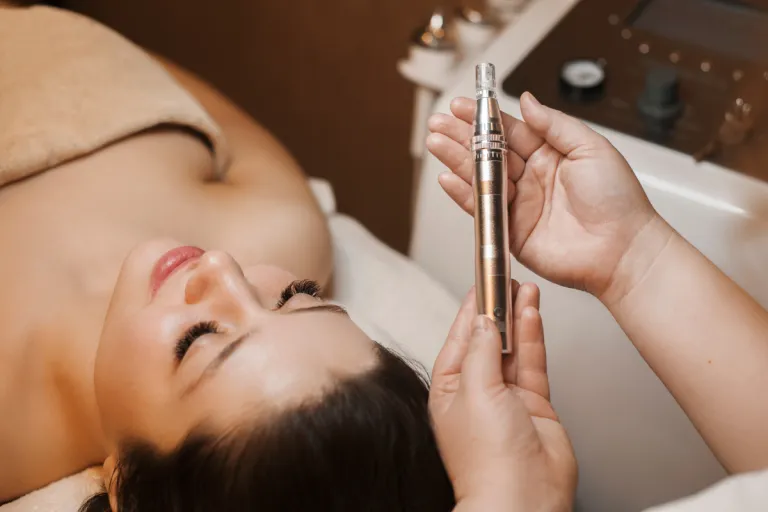
If you’re researching microneedling side effects, you’re doing the right thing. Most med spa blogs either gloss over recovery with “minimal downtime” or list every theoretical complication without context. Neither is particularly useful when you’re trying to decide whether to book an appointment or figure out what’s happening with your skin post-treatment.
This post covers the full arc — who shouldn’t get microneedling, what the treatment actually feels like, what’s normal during recovery, how to take care of your skin afterward, and when something might genuinely warrant a call to your provider.
Who Should Not Get Microneedling
Before discussing side effects, it’s worth addressing who should skip the treatment entirely. These aren’t soft suggestions — they’re clinical contraindications.
Active acne or skin infections: Microneedling over active breakouts, cold sores, bacterial infections, or fungal infections can spread the infection across the treatment area. If you have a few isolated pimples, your provider may be able to work around them. If you’re in an active flare, the treatment needs to wait until the skin has cleared.
Accutane (isotretinoin) use within the past six months: Isotretinoin significantly impairs wound healing by thinning the skin and suppressing the sebaceous glands. Most providers require at least six months off the medication before microneedling, though some recommend waiting a full year.
Blood clotting disorders or blood-thinning medications: Microneedling creates controlled micro-injuries that rely on a normal clotting response. If clotting is impaired, the risk of excessive bleeding and poor wound healing increases. Discuss your medications with your provider before scheduling.
Active eczema, psoriasis, or rosacea in the treatment area: Microneedling on skin that’s already inflamed and compromised will worsen the condition, not improve it. Some patients with well-controlled rosacea can be candidates for certain microneedling protocols, but this requires careful assessment.
Pregnancy: Microneedling is generally not recommended during pregnancy due to infection risk and concerns about serum ingredients that may be applied during treatment. We cover this in detail in our post on microneedling during pregnancy and breastfeeding.
Keloid-prone skin: If you have a history of keloid scarring, microneedling may trigger an abnormal healing response. This doesn’t mean you’re automatically disqualified, but it does mean your provider needs to know about it and may adjust the treatment approach or recommend a test patch first.
Recent radiation therapy to the treatment area: Irradiated skin has compromised healing capacity and should not undergo microneedling until cleared by your oncologist.
What Microneedling Actually Feels Like
The honest answer: it’s uncomfortable but manageable for most people. Describing it as “painless” — which some providers do — is not accurate. Describing it as very painful is also overstating it for the majority of patients.
Before treatment, a topical numbing cream is applied for 20 to 30 minutes. Once the numbing has taken effect, most patients describe the sensation as a vibrating, scratchy pressure — like sandpaper being moved across the skin. Some areas are more sensitive than others. The forehead and temples tend to be more uncomfortable than the cheeks. The area around the nose and upper lip is typically the most sensitive spot on the face. The neck, as we discuss in our post on microneedling the neck, can be slightly more sensitive due to thinner skin.
Needle depth matters for comfort. Treatments at 0.5 to 1.0mm are generally well-tolerated even in sensitive areas. Deeper treatments at 1.5 to 2.5mm — which are used for scarring and more significant collagen induction — are more intense. RF microneedling adds a brief heat sensation from the radiofrequency energy, which some patients describe as a warm prickling.
The entire treatment takes roughly 20 to 40 minutes depending on the area being treated. Most patients find it tolerable. A small percentage find it genuinely uncomfortable, particularly at deeper needle depths. If you have a very low pain tolerance, let your provider know — additional numbing or a modified approach can help.
Normal Side Effects and Recovery Timeline
Here’s what to expect after a standard microneedling treatment, broken down by timeframe.
Immediately after treatment: Your skin will be red — visibly, obviously red, similar to a moderate sunburn. This is the intended inflammatory response. You may also notice some pinpoint bleeding during the treatment itself, which stops quickly. Mild swelling is common, especially around the eyes and forehead. Your skin will feel warm and tight.
Day one (first 24 hours): Redness persists. The skin feels sensitive and may sting slightly, particularly if anything touches it. Some patients notice mild swelling that’s more apparent in the morning. This is all normal. Your face may feel dry and tight as the micro-channels begin closing.
Days two to three: Redness begins fading for most patients. The skin may start feeling rough or sandpapery as the surface layer turns over. Some patients notice mild peeling or flaking, similar to what you’d see after a mild sunburn. The sensitivity is decreasing but still present.
Days four to seven: Most visible side effects have resolved. The skin may still be slightly pink in some areas, but this is typically concealable with mineral makeup (more on makeup timing below). The rough texture smooths out as dead skin cells shed naturally. By day seven, most patients look and feel normal.
RF microneedling recovery follows a similar pattern but tends to run slightly longer. Expect two to four days of more noticeable redness and swelling compared to standard microneedling, with full resolution typically by seven to ten days. The deeper energy delivery means a more robust healing response, which is part of how it achieves additional tightening — but it also means more visible downtime.
Aftercare: What to Do (and Avoid) After Treatment
Follow the aftercare instructions for your exact device and procedure. Microneedling changes the skin barrier; increased permeability does not establish that an added serum is appropriate. Device clearance and combination treatments: The FDA has not cleared microneedling devices for use with PRP or another product. Clearance of a device for its labeled indication does not establish the safety or effectiveness of that combination. Discuss the exact device, proposed use, alternatives, and risks with the treating clinician.
First 24 hours — keep it simple. Gentle cleanser and the post-treatment products your provider recommends, and nothing else. No makeup, no sunscreen (stay out of the sun instead), no active ingredients. Clean hands only when touching your face. Sleep on a clean pillowcase. Avoid sweating — skip the gym, the sauna, and hot showers directed at your face.
Days two to three — still minimal. You can typically resume a gentle moisturizer and mineral sunscreen at this point. Continue avoiding retinoids, vitamin C, AHAs, BHAs, and other active ingredients. No exfoliating — physical or chemical. Your skin is still healing, and actives will irritate it at best, cause a reaction at worst.
Makeup timing: Most providers recommend waiting at least 24 hours before applying any makeup, and 48 to 72 hours is preferable. When you do resume, start with mineral-based makeup, which is less likely to irritate healing skin or clog the micro-channels that haven’t fully closed. Heavy liquid foundations and setting powders should wait until day five to seven. If you have an event that requires full makeup within 48 hours, you should schedule your treatment with more buffer time.
Sun exposure: This is the single most important aftercare instruction. Your skin is significantly more vulnerable to UV damage during the healing window. Wear SPF 30 or higher daily (mineral sunscreen is preferred over chemical for the first week), avoid direct sun exposure as much as possible, and wear a hat if you’ll be outside. Sun damage during the healing phase can cause hyperpigmentation that’s more difficult to treat than whatever you were microneedling for in the first place.
Resuming your full skincare routine: Most patients can return to their complete routine — including retinoids, vitamin C, and medical-grade skincare products — by day five to seven. Your provider will give you specific guidance based on your skin’s sensitivity and the depth of your treatment. Don’t rush this. An extra day or two of gentle products is always better than an irritation flare from reintroducing actives too early.
Can Microneedling Cause Breakouts?
Yes, and this is normal in many cases — but it’s worth understanding what’s happening so you can tell the difference between a temporary response and a real problem.
Post-microneedling breakouts typically fall into two categories. The first is purging — the accelerated cell turnover from microneedling brings existing microcomedones (clogged pores that hadn’t yet surfaced) to the surface faster than they would have on their own. These breakouts appear within the first week or two post-treatment, occur in areas where you normally break out, and resolve on their own relatively quickly. This is a temporary reaction to the skin-renewal process, not a complication.
The second is actual breakouts from post-treatment contamination — touching your face with unwashed hands, applying heavy or comedogenic products too soon, or sweating during the initial healing window when the micro-channels are still open. These breakouts can appear anywhere, not just in your usual problem areas, and may include signs of infection like unusual warmth, pain, or pus.
If breakouts persist beyond two weeks, are painful, or look infected, contact your provider. For patients who are acne-prone, let your provider know before treatment so they can adjust the post-treatment protocol — certain serums and aftercare products are better suited for breakout-prone skin.
Can Microneedling Damage Your Skin?
When performed by a trained provider using professional equipment at appropriate settings, microneedling has a strong safety profile. The controlled micro-injuries are the mechanism by which the treatment works — the “damage” is the point, and the body’s repair response is what produces results.
Training, technique, patient selection, and aftercare affect risk, but complications can occur even with professional care. Discuss infection, pigment changes, scarring, and other device-specific risks before treatment.
It’s worth noting the difference between professional devices and consumer derma rollers. Professional microneedling pens use vertically stamping needles at depths of 1.0 to 2.5mm, creating clean channels that heal predictably. Consumer derma rollers use rolling needles at shallow depths (typically 0.25mm) that enter the skin at an angle, which can cause micro-tearing rather than clean punctures. The two are fundamentally different tools producing fundamentally different effects — and the risks associated with improper at-home use shouldn’t be confused with professional treatment.
Darkening or lightening of skin and other complications are recognized microneedling risks. Darker skin tones need careful assessment; risk should not be described solely as a provider-experience issue. FDA also warns of serious complications reported with RF microneedling, which is a distinct procedure with additional thermal risks.
Downtime: How Much Time Should You Actually Block Off?
The word “downtime” gets used loosely. Here’s what it means in practical terms — can you go to work, can you be seen in public, and can you exercise?
Standard microneedling: Plan for 24 to 48 hours of social downtime. You’ll be visibly red on day one. By day two, most patients can conceal remaining pinkness with mineral makeup if needed. You can return to work on day two for most jobs. Avoid exercise for 48 hours. Full normalcy by day five to seven.
RF microneedling: Plan for two to four days of social downtime. The swelling and redness are more pronounced. Day one and two will be clearly visible. By day three to four, mineral makeup can typically cover remaining pinkness. Return to exercise at day three to four. Full normalcy by day seven to ten.
Vivace RF microneedling tends to produce somewhat less downtime than some other RF devices due to its design, but still expect more recovery than standard microneedling.
If you have a specific event or commitment, build in buffer time. We discuss how to plan treatment around real-life timelines in our post on microneedling sessions and results.
When to Contact Your Provider
Most microneedling side effects are predictable and self-resolving. However, contact your provider if you experience any of the following: redness or swelling that worsens after day three rather than improving, signs of infection (increasing pain, warmth, pus, or spreading redness), severe or prolonged bruising, blistering or open wounds, or an allergic reaction to any products applied during or after treatment.
These complications are uncommon with professional treatment, but knowing what’s outside the range of normal gives you a clear signal for when to pick up the phone rather than waiting it out.
If you have questions about whether microneedling is appropriate for your skin type and concerns, or want to discuss what your specific recovery would look like, a consultation is the best place to start.
Learn more about microneedling at ELLEMES Medical Spa →
Book a complimentary consultation →
ELLEMES Medical Spa is located at 5505 Peachtree Dunwoody Road in Sandy Springs, GA — serving patients from Buckhead, Brookhaven, Dunwoody, and greater Atlanta.