
What Age Should You Start Botox? A Realistic Guide to Preventative Botox
There’s no magic age. That’s the honest answer, and any provider who tells you “everyone should start at 25” or “you don’t need it until 40” is oversimplifying a decision that depends entirely on your anatomy, your genetics, and what’s actually happening on your face right now.
Preventive Botox describes an intended cosmetic approach, not a separate FDA-approved indication for preventing future wrinkles. Decisions should be based on current concerns, risks, and alternatives rather than pressure to start at a particular age.
What “Preventative Botox” Actually Means
The term gets used loosely, so let’s define it. Preventative Botox means using small doses of Botox before deep, permanent wrinkles have formed — with the goal of slowing down or preventing those wrinkles from developing in the first place.
The logic is straightforward. Wrinkles on the upper face — forehead lines, frown lines, crow’s feet — are caused by repeated muscle contraction over time. Every time you raise your eyebrows, squint, or furrow your brow, the overlying skin folds in the same spot. When you’re young, the skin snaps back. As collagen depletes with age, those fold lines start to linger even when your face is at rest. Eventually, they become etched into the skin permanently — what’s called a static wrinkle.
Reducing muscle activity can temporarily reduce selected expression lines. It does not establish that beginning treatment young will prevent future static wrinkles or reduce lifelong treatment needs.
The Age Range Where Most People Start
Most patients who come to ELLEMES for preventative Botox are between 27 and 35. That’s a wide range, and it should be — because the right age to start has almost nothing to do with the number on your driver’s license and everything to do with what your facial muscles are doing.
Some patients at 25 already have a visible “11” between their brows when their face is completely at rest. They’ve inherited strong corrugator muscles from a parent who has deep frown lines, they work at a computer all day squinting at a screen, and the line is starting to set in. For that patient, starting Botox at 25 is clinically reasonable.
Other patients at 35 have minimal lines at rest — good genetics, consistent sunscreen use, not particularly expressive in the forehead area. For that patient, starting at 35 would be considered preventative rather than corrective, even though they’re a decade older than the first example.
A more useful question is whether you have a current concern for which the likely benefit outweighs the risks and costs.
How to Tell If You’re Ready
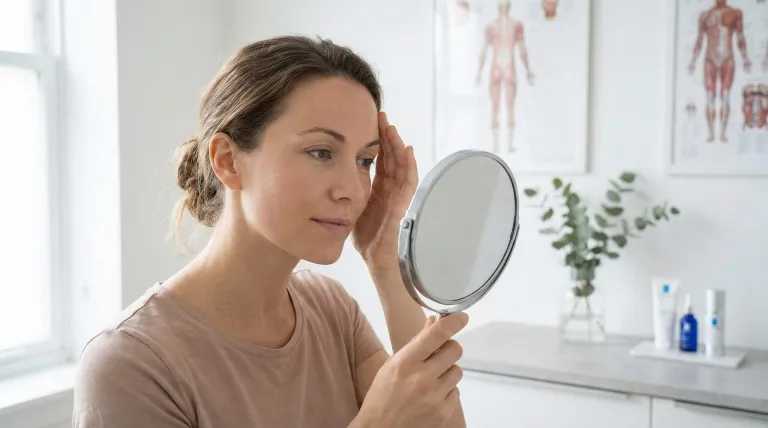
There’s a simple test you can do at home, though it’s not a substitute for a professional assessment.
Stand in front of a mirror in natural light. Make each of the following expressions, then relax your face completely:
Raise your eyebrows, then relax. Do the horizontal lines across your forehead disappear completely, or can you still see faint traces of them?
Frown as hard as you can, then relax. Do the vertical lines between your brows vanish, or do you see a crease that stays even when you’re not frowning?
Smile wide, then stop smiling. Do the lines at the corners of your eyes disappear, or do fine lines linger?
If the lines vanish completely when your face is at rest, you have dynamic wrinkles only — lines that appear with movement and disappear without it. You may or may not be ready for preventative Botox depending on how deep those dynamic lines are and how concerned you are about them progressing.
Lines at rest can be discussed at an assessment, but they do not establish that you need injections or are at a uniquely effective prevention window.
What Preventative Botox Looks Like in Practice
Preventative Botox is not the same as a full corrective treatment. The approach is different in three key ways:
Dose should follow the product-specific indication and individual assessment, not an age-based preventive formula. ELLEMES prices Botox at $13 per unit; ask for the proposed product, dose, rationale, and total quote before treatment.
The areas treated depend on assessment and the labeled protocol. For BOTOX Cosmetic, the approved forehead-line protocol includes glabellar-line treatment; do not select an isolated forehead dose from an online guide.
Potentially longer intervals. Some younger patients with milder muscle activity find that their results last longer than the standard 3–4 months — sometimes 4–6 months — because the muscles weren’t as strong to begin with. Over time, with regular treatment, the muscles can weaken further from disuse, which means some patients find they need less Botox and less frequently as the years go on.
When It’s Too Early
Preventative Botox is not appropriate for everyone in their twenties. There are clear situations where starting Botox isn’t the right call:
You have no visible lines, dynamic or static. If your face shows no lines when you move it and no lines when it’s at rest, there’s nothing to prevent yet. You don’t need Botox at this point, regardless of your age. Check back in a year or two if you’re curious.
You haven’t established a basic skincare routine. Sunscreen, retinoid, and moisturizer will do more for wrinkle prevention in your early-to-mid twenties than Botox will. If you’re not wearing SPF 30+ daily, that’s a better starting investment than injectables. Sun damage is the single largest accelerator of visible aging — Botox can’t undo what UV exposure does to your collagen.
You’re motivated by anxiety rather than observation. If you’re 23 and panicking because someone on social media said you’ll “look old” without Botox, that’s not a clinical indication. A good provider will tell you this directly. At ELLEMES, if a patient comes in for a consultation and we don’t see a reason to treat, we’ll say so — and we won’t charge for the consultation.
What About Starting “Late”?
Age alone does not decide suitability or guarantee that treatment will work.
In older adults, current skin condition, anatomy, medical history, and goals determine whether treatment is appropriate. Some lines at rest may persist, and treatment does not guarantee prevention of further deepening.
That’s where combination approaches become relevant. For static wrinkles that persist even after Botox:
Chemical peels can resurface the skin and soften the appearance of etched lines.
Microneedling stimulates collagen production in the deeper skin layers, which can gradually plump and fill in static wrinkles from beneath.
Laser treatments like Sciton MOXI address both texture and collagen remodeling for more significant improvement.
Dermal fillers can fill deeper folds and restore volume that’s been lost with age — particularly in the cheeks, temples, and nasolabial folds where volume loss contributes to a tired appearance.
Starting Botox at 50 and combining it with resurfacing treatments can still produce a dramatic improvement in how the face looks at rest. You didn’t miss the window — you just may need a more comprehensive plan than someone who started at 30.
The Role of Genetics and Lifestyle
Two factors matter more than age when it comes to when wrinkles develop:
Genetics. Look at your parents’ faces. If your mother has deep forehead lines or your father has prominent crow’s feet, you’re more likely to develop those same patterns — and possibly at a similar age. Genetics determine your baseline collagen structure, skin thickness, and how your muscles attach to your skin. There’s no overriding that blueprint, but you can slow down its expression with strategic treatment.
Sun exposure history. Cumulative UV damage breaks down collagen and elastin faster than anything else. A 30-year-old who grew up in outdoor sports without sunscreen may have more collagen damage than a 40-year-old who’s been diligent about sun protection their entire life. If you grew up in Atlanta and spent every summer at the lake or the pool, your skin has a UV history that matters — and that history affects when preventative treatment becomes relevant.
Other accelerators: smoking (significantly speeds collagen breakdown), chronic dehydration, poor sleep, and high stress. None of these mean you “need” Botox — but they can shift the timeline forward.
A Practical Approach by Decade
This is a generalization, not a prescription. Every patient is different. But as a framework:
Early adulthood. Sun protection and a suitable skincare routine are reasonable starting points. Discuss active ingredients with a qualified provider; retinoids are not appropriate for everyone, including during pregnancy. There is no required age to begin injections.
Late twenties to early thirties. Discuss a current concern if you have one; there is no standard preventive injection protocol that everyone in this age group should follow.
Mid 30s to 40s. Most patients in this range are transitioning from purely preventative to a mix of prevention and correction. Lines are more established, and the full upper-face treatment (forehead, frown, crow’s feet) becomes more common. This is also when patients start considering combination treatments — Botox for the dynamic component plus resurfacing or fillers for the static component.
Later adulthood. A consultation can assess whether a neuromodulator, another treatment, or no procedure is the best fit. An effective result is not guaranteed at any age.
How to Find Out Where You Stand
The fastest way to answer “should I start Botox?” is a consultation where your provider looks at your face in motion and at rest, evaluates your muscle patterns, and tells you directly whether treatment makes sense now or whether you’d be better off waiting.
At ELLEMES, consultations are complimentary, and we don’t treat patients who don’t need treatment. If you come in at 26 and your skin doesn’t show any indication for Botox, we’ll tell you that, recommend a skincare plan, and suggest you check back in a year or two. If you come in at 32 and your frown lines are starting to set, we’ll show you exactly where, explain how many units would address it, and give you the cost before any decision is made.
Either way, you’ll leave with a clear answer — not a sales pitch.
Learn more about Botox at ELLEMES Medical Spa →
Book a complimentary consultation →
ELLEMES Medical Spa is located at 5505 Peachtree Dunwoody Road in Sandy Springs, GA — serving patients from Buckhead, Brookhaven, Dunwoody, and greater Atlanta.
Sources for the clinical information: BOTOX Cosmetic prescribing information; American Academy of Dermatology: preparing for treatment.