
Dysport vs. Botox: What's Actually Different?
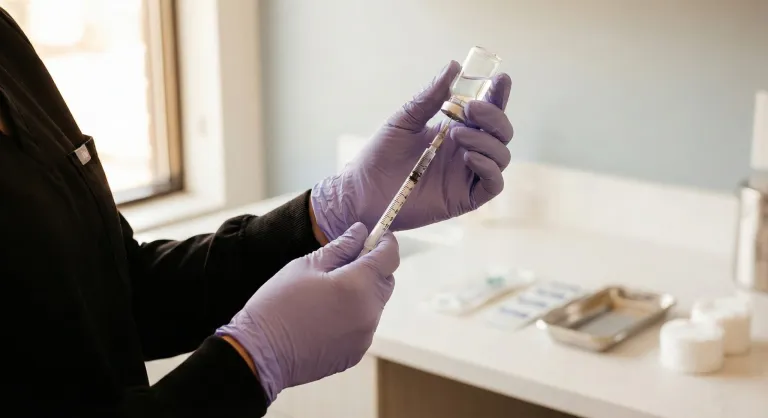
Dysport and Botox are botulinum toxin type A products with different formulations, potency units, and approved indications. Both can temporarily reduce selected expression lines, but they are not interchangeable.
So why do two products exist? Because they’re formulated differently, and those formulation differences create subtle but real clinical distinctions in how they behave once injected. This post explains what those distinctions are, when they matter, and when the choice between Dysport and Botox comes down to provider preference and patient experience rather than clinical superiority.
The Shared Foundation
Before getting into differences, it’s worth establishing what Dysport and Botox have in common — because the similarities are more significant than the differences.
Both products have a cosmetic indication for glabellar lines. BOTOX Cosmetic also has approved uses for lateral canthal lines, forehead lines treated with glabellar lines, and platysma bands in adults. Dysport’s cosmetic approval is for moderate to severe glabellar lines in adults younger than 65; its other aesthetic uses are off-label.
Both labels contraindicate use with relevant hypersensitivity or infection at the injection site. Dysport additionally lists cow’s milk protein allergy. Neuromuscular disorders increase risk and need assessment; pregnancy and breastfeeding involve insufficient safety data rather than the same formal contraindication list.
If you’ve been told that one product is fundamentally safer or more effective than the other, that’s an oversimplification. The clinical evidence shows comparable safety and efficacy profiles when both are dosed appropriately.
Onset: Results Vary
Onset depends on the product, treatment area, dose, and individual response.
Both products can begin working within days. Do not choose an appointment date on the assumption that one product will reliably produce a finished result by a particular event.
Protein-complex size alone does not establish a clinically predictable onset advantage. Allow time for results, bruising, and follow-up, and agree on event timing with your clinician.
For patients who are maintaining regular treatment every 3–4 months, the onset difference is less relevant — you’re not timing treatments to events, you’re maintaining a consistent baseline.
Spread: Dose, Placement, and Anatomy Matter
An effect on a neighboring muscle is possible with either product.
A simple rule that Dysport always spreads farther and Botox always stays at one injection point is not a reliable basis for product selection. Dose, dilution, volume, technique, and anatomy affect the result.
Forehead treatment requires careful assessment of brow position and muscle activity. BOTOX Cosmetic has a labeled forehead-with-glabellar protocol; Dysport forehead use is off-label.
For areas close to the eyes, the clinician must assess the risk of eyelid or neighboring muscle weakness with either product. Neither product guarantees precision or freedom from diffusion-related effects.
Ask your injector about experience with the specific product and indication, rather than relying on a promise that one product will spread in a fixed way.
Dosing: The Units Are Not Interchangeable
Botox and Dysport potency units are not interchangeable. Their labels specifically say the units cannot be compared or converted between products.
A quoted billing quantity is not a clinical potency-unit conversion. The product, actual dose, and price should be explained separately.
At ELLEMES, Botox costs $13 per Botox unit. Dysport is priced at $13 per Botox-equivalent billing unit. A billing unit is a pricing convention, not an actual Dysport potency unit or a clinical conversion rule. Your injector will explain the product-specific dose and total quote before treatment.
Duration: Roughly the Same
Both Dysport and Botox last approximately 3 to 4 months for most patients. Some studies have suggested that Dysport may wear off slightly faster for some patients, while others have found no meaningful difference. In practice, the variation between individual patients (based on metabolism, muscle strength, and treatment area) is greater than the variation between the two products.
How long an individual treatment lasts cannot be reliably predicted from exercise habits or a claimed metabolic rate. Discuss your observed response rather than changing healthy exercise habits to extend an injection’s effect.
If you’re finding that one product wears off noticeably faster for you, that’s a legitimate reason to try the other. Individual response to the two formulations can differ, and some patients do better on one than the other — even though the average duration is similar.
The “Feel” Factor
This is subjective and anecdotal, but worth mentioning because patients bring it up frequently. Some patients report that Dysport produces a “softer” or more natural-feeling result than Botox — that the treated area feels less “locked” and more like natural reduced movement. Others notice no difference.
A perceived softer result is subjective. It does not establish that one formulation is inherently more natural or that a particular diffusion mechanism caused the difference.
Explain how much movement you wish to preserve during your consultation; neither brand guarantees a particular feel or appearance.
When the Choice Genuinely Matters
Product choice should follow the approved indication, clinical assessment, medical history, and prior response—not a universal ranking of one brand over another.
Discuss Dysport if you are considering its approved glabellar-line indication or a clinician has explained the rationale and uncertainties for an off-label use. Do not choose it solely to meet a last-minute event deadline.
Discuss BOTOX Cosmetic if its approved indications match your concerns. Prior experience can inform the conversation, but it does not eliminate risk.
Bunny lines, chin dimpling, lip flips, and masseter treatment are off-label uses. Neck-band approval is product-specific; BOTOX Cosmetic’s platysma-band approval does not apply to Dysport.
Switching Between Products
Switching products requires a clinician’s assessment and review of recent injections; it is not automatically risk-free.
Tell your injector the product, date, and dose of every recent botulinum toxin treatment. The labels warn that administering another product before the previous effect has resolved may increase weakness; the effect of combining different products close together is not established.
When switching, the clinician must choose a product-specific dose. A fixed Botox-to-Dysport conversion should not be presented as patient dosing advice.
If you are considering a switch, discuss the reason, timing, alternatives, and risks. The effect is usually temporary but cannot be immediately reversed.
What Matters More Than the Product
Injector expertise matters, alongside the product’s label, your anatomy and medical history, and the dose. No product or provider can guarantee an outcome.
Anatomy assessment: Where are your strongest muscles? Where are your wrinkles deepest? Where does your brow naturally sit? An injector who doesn’t evaluate these factors before injecting is dosing by template rather than by your face.
Too much or too little effect may have several causes. A clinician should assess the result rather than promising that a particular unit adjustment will fix it.
Placement precision: The exact location and depth of each injection point determines which muscle fibers are relaxed and which remain active. This is what separates a natural-looking result (smooth forehead with a mobile brow) from an unnatural one (smooth forehead with a heavy, dropped brow).
At ELLEMES Medical Spa in Sandy Springs, both Dysport and Botox are available. Your injector will recommend the product that best suits the treatment area and your personal preferences — but the clinical decisions about where, how much, and at what depth to inject are where the real results come from.
What Neither Product Can Do
Both products can reduce the appearance of selected expression lines. They do not restore volume or act as skin-resurfacing treatments; lines visible at rest may persist.
If lines remain at rest, ask your clinician what degree of improvement is realistic and whether another approach is appropriate. No neuromodulator guarantees that a wrinkle will stop progressing.
If your concern is lost volume — hollow cheeks, thin lips, a recessed chin — neither neuromodulator will help. Dermal fillers address structural volume loss, and many patients combine neuromodulators (upper face) with fillers (mid and lower face) for comprehensive facial rejuvenation.
If your skin has sun damage, redness, or uneven tone, those are surface-layer concerns. BBL and RF microneedling address the skin itself, while neuromodulators work on the muscle beneath it. The best comprehensive plans treat both layers.
Learn more about Dysport at ELLEMES Medical Spa →
Book a complimentary consultation →
ELLEMES Medical Spa is located at 5505 Peachtree Dunwoody Road in Sandy Springs, GA — serving patients from Buckhead, Brookhaven, Dunwoody, and greater Atlanta.
Sources for the clinical information: BOTOX Cosmetic prescribing information; Dysport prescribing information.