
MOXI Laser Downtime: What to Expect Day by Day
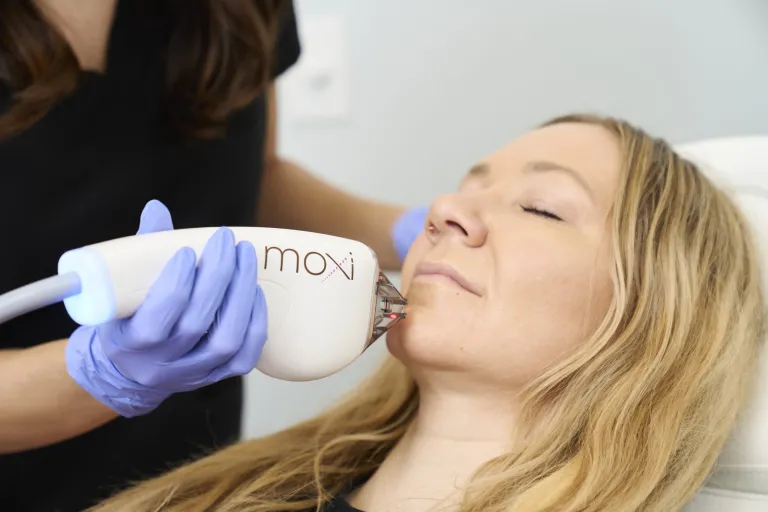
MOXI can produce visible redness, swelling, and roughness after its fractional thermal injury. Three to five days is a common planning estimate, not a guarantee of complete recovery. The day-by-day guide below is illustrative; follow your treating provider’s instructions and seek assessment for concerning symptoms.
What Causes the Downtime: Understanding MENDs
MOXI’s 1927 nm energy targets water and creates microscopic treatment zones. Sciton describes a superficial depth of roughly 100–200 micrometers. Damaged epidermal debris can shed during recovery; this is not a description of a primarily deep dermal treatment.
Fine bronzing or a sandpaper-like texture can accompany healing, but appearance alone cannot distinguish normal debris from a complication. Worsening pain, blisters, discharge, or spreading redness should be assessed rather than labeled proof the treatment is working.
Day by Day: What to Expect After MOXI
Day of treatment: Immediately after the laser pass, the skin looks and feels sunburned — red, warm, and slightly swollen. This is a normal acute inflammatory response. Your provider applies a calming serum and moisturizer before you leave the appointment. Most patients can drive themselves home. The redness is visible but not alarming, and for most skin tones it reads as a pronounced flush rather than anything dramatic. Plan to go home rather than out to dinner.
Day 1: redness, warmth, tightness, or swelling may continue. Use only the recovery products advised for your treatment. Makeup and active skincare timing depend on skin recovery; passing twenty-four hours alone does not establish that every product is appropriate. Follow the provider’s sun-protection plan.
Days 2–3: This is typically when the MEND texture is most pronounced. The skin develops a fine, sandpaper-like surface — small dark specks that can look like a grid pattern on close inspection. This is most noticeable in bright light or when running a finger across the skin. It can be camouflaged with foundation, and most patients find it manageable in social or professional settings with makeup. Without makeup, it is visible up close. Sun exposure should be avoided entirely during this window — a walk to your car is fine; an hour on the patio is not. Keep the skin well moisturized; the MEND texture is less visible on hydrated skin.
Days 3–5: The MENDs begin to shed. The skin may look slightly flaky or peel in fine sheets, particularly around the nose, mouth, and forehead where cell turnover is faster. This shedding is not the same as the thick peeling associated with a medium chemical peel — it is subtle and often mistaken for dry skin. Do not manually exfoliate or pick at the shedding skin. Let it shed on its own timeline. As the MENDs clear, the skin underneath begins to look cleaner, brighter, and more even. Most patients notice a visible improvement in tone by day five or six.
Days 5–7: many patients improve, but redness, texture changes, and sensitivity may last longer. Restart active skincare when the treating clinician advises and the skin has recovered, rather than treating day seven as automatic clearance for retinoids.
Weeks 2–6: This is when the results from the treatment become meaningfully visible. Collagen remodeling initiated by the laser continues for weeks after the MENDs have shed. Pigmentation continues to improve as the new skin fully matures. Most patients see the clearest improvement in tone, texture, and overall skin quality at the four to six week mark — not in the days immediately following treatment. Managing expectations around this timeline is one of the more important parts of the pre-treatment conversation.
How to Manage Recovery More Comfortably
Moisturize consistently: Well-hydrated skin sheds MENDs more comfortably and looks less visibly textured during the recovery window. A plain, fragrance-free barrier moisturizer applied generously two to three times per day is the most practical thing you can do during the first week. Avoid anything with active ingredients — the goal is to support the skin barrier, not accelerate cell turnover further while the skin is in recovery mode.
SPF every day without exception: The skin is more photosensitive after laser treatment, and sun exposure during the recovery window can trigger post-inflammatory hyperpigmentation — the very outcome the treatment is working to correct. Apply broad-spectrum SPF 30 or higher every morning as the first step of your routine, and reapply if you’re spending meaningful time outdoors. This is not optional during recovery, and it remains important for several weeks after treatment.
Do not pick, scrub, or manually exfoliate: It is tempting to help the MENDs shed faster, but mechanically disrupting the shedding process can cause irritation, prolong recovery, and in some cases cause hyperpigmentation. The skin will shed on its own schedule. Gently cleanse with a soft cloth or fingertips, pat dry, and leave the rest alone.
Avoid heat environments: Saunas, steam rooms, very hot showers, and hot yoga should be avoided for the first five to seven days. Heat increases inflammation and can worsen redness and swelling during the acute recovery phase.
Time your appointment strategically: If you have a wedding, a work presentation, or any event where you need your skin to look its best, schedule your MOXI session at least ten to fourteen days beforehand — ideally three to four weeks out. That gives the MENDs time to fully shed and allows some of the early collagen improvement to become visible. Booking MOXI three days before a significant event is not an appropriate timeline, regardless of how manageable the downtime sounds on paper.
How MOXI Downtime Compares to Other Treatments
Compared with ablative resurfacing, MOXI generally involves less extensive surface injury, but recovery depends on the exact procedure and settings. Fractional and full-field ablative treatments also differ. Neither a fixed downtime nor a particular level of correction can be guaranteed by the category alone.
Standard microneedling may have a short visible recovery, but bleeding, crusting, pigment changes, infection, and prolonged effects are possible. It should not be presented as automatically easier or interchangeable with MOXI.
Vs. chemical peels: A medium-depth chemical peel produces more pronounced peeling — thicker, more visible shedding over five to seven days — than the fine MEND texture MOXI generates. A light peel may have similar downtime to MOXI. Depth of peel determines the comparison; it’s not a clean across-the-board statement that one is easier than the other.
IPL can produce darkening and subsequent shedding of treated pigment. It uses different energy and targets from MOXI, but the contrast is not “IPL only pigment, MOXI only dermal collagen.” Recovery and suitability depend on the exact procedure.
What MOXI Downtime Won’t Do for Your Skin
A single MOXI session is not a dramatic resurfacing procedure. The three-to-five day recovery does not translate to dramatic overnight correction. Patients with deep wrinkles, severe acne scarring, or significantly advanced sun damage should not expect MOXI’s recovery profile to correspond to the level of correction those concerns require. More aggressive concerns typically require either multiple MOXI sessions over a series, a more intensive laser modality, or a combination approach — something your provider can map out at consultation.
The MOXI service page covers pricing, session protocols, and the full range of concerns the treatment addresses. For patients weighing MOXI against BBL or considering combining both, our providers can walk through what each treatment contributes in the context of your specific skin at a complimentary consultation.
Learn more about MOXI Laser at ELLEMES Medical Spa →
Book a complimentary consultation →
ELLEMES Medical Spa is located at 5505 Peachtree Dunwoody Road in Sandy Springs, GA — serving patients from Buckhead, Brookhaven, Dunwoody, and greater Atlanta.
Sources for the clinical information: Sciton MOXI information; FDA microneedling device guidance.