
Plasma Pen for Hooded Eyelids: What It Can and Cannot Do
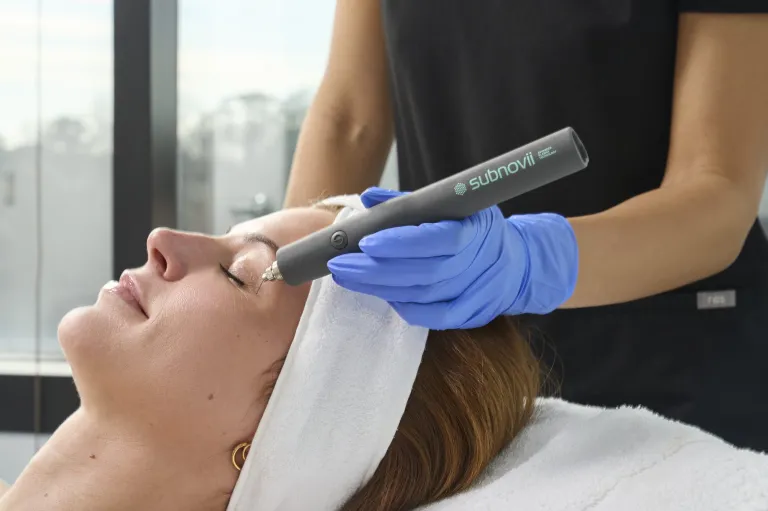
Patients with hooded eyelids sometimes ask about plasma pen treatment as an alternative to surgery. Suitability depends on the cause of hooding, eye health, skin type, and goals. SubNovii’s K201738 clearance is for skin-lesion removal/destruction and tissue coagulation; it does not establish an FDA-cleared eyelid-lift indication or guarantee a lift.
Why Eyelids Hood in the First Place
Upper eyelid hooding develops from a combination of factors, and the specific cause matters when choosing a treatment. The most common driver is skin laxity — the thin eyelid skin loses collagen and elastin over time, and the resulting excess folds over the crease. This is the scenario where plasma pen is most effective, because the treatment directly contracts and tightens skin.
But hooding can also result from brow descent, where the forehead and brow drop with age and push skin downward onto the eyelid. In this case, the eyelid skin itself may not be the primary problem — the brow position is. Treating the eyelid alone addresses a symptom rather than the cause. Fat pad herniation, where orbital fat pushes forward and creates puffiness, is another contributor that plasma pen cannot address. These distinctions are why a consultation is required before treatment — the source of your hooding determines whether fibroblast therapy is the right approach.
How Plasma Pen Treats the Upper Eyelid
SubNovii generates an electrical arc between an electrode held above the skin and the skin itself. The electrode does not touch the skin, but the energy acts on and injures tissue; non-contact delivery does not mean risk-free treatment.
Cosmetic improvement, if achieved, varies. Device precision does not guarantee that adjacent tissue or the eye cannot be harmed. A qualified clinician should assess periocular suitability, precautions, and alternatives before treatment; our Plasma Pen service page describes the consultation process.
What Mild-to-Moderate Hooding Looks Like
This is the candidacy question that matters most, and it is harder to answer from a webpage than from an in-person evaluation. That said, there are general guidelines.
Mild hooding: The upper eyelid skin folds slightly over the crease but does not reach the lash line. The eye still appears open, but the lid looks heavier than it used to — particularly in photos or toward the end of the day when muscles fatigue. One session of plasma pen typically produces a noticeable improvement for this degree of laxity.
Moderate hooding: The excess skin folds more significantly over the crease and may partially obscure the upper lash line. Eye makeup application becomes more difficult. The eye appears smaller or more tired than it is. This level of hooding often benefits from a series of 2 to 3 plasma pen sessions spaced 8 to 12 weeks apart, with each session building on the contraction achieved by the previous one.
Severe hooding: The excess skin hangs over the lash line and may interfere with peripheral vision. The lid crease is fully obscured. At this point, the volume of excess tissue exceeds what fibroblast therapy can contract, and surgical blepharoplasty is the more appropriate recommendation. Plasma pen may still play a role post-surgery for fine-tuning, but it is not the primary intervention for this degree of hooding.
Realistic Results: What One Session Accomplishes
A single session may produce cosmetic change, but the amount and durability cannot be predicted for every eyelid. The FDA clearance cited here does not establish a typical amount of eyelid lift from one session.
What a single session will not do is eliminate all excess skin on a moderately hooded eyelid. If your hooding took 15 years to develop, one 20-minute treatment is not going to reverse it entirely. The collagen remodeling that drives the final result takes 8 to 12 weeks to complete, and your provider will evaluate the response at that point to determine whether additional sessions are warranted.
Patients who expect a dramatic, surgery-level correction from one session tend to be disappointed. Patients who understand that fibroblast therapy produces progressive, cumulative tightening over a series tend to be satisfied. Setting expectations accurately is half the job.
Plasma Pen vs. Surgical Blepharoplasty
Blepharoplasty can remove or reposition excess tissue. Plasma treatment produces thermal tissue injury and should not be represented as an equivalent, reversible version of surgery. Both approaches require a discussion of risks and realistic benefits.
A non-surgical option may be discussed for selected concerns, but avoiding an incision does not establish that plasma pen is the stronger or safer choice. Surgical anesthesia and recovery also vary; general anesthesia is not required for every blepharoplasty.
When blepharoplasty is the stronger choice: Severe hooding that obstructs vision. Significant excess skin that cannot be sufficiently contracted by thermal energy alone. Cases involving fat pad herniation or significant brow ptosis where the eyelid skin is not the primary problem.
On cost: Plasma pen eyelid treatment at ELLEMES starts at $600 per area. Surgical blepharoplasty typically ranges from $3,000 to $7,000 or more when you factor in surgeon fees, anesthesia, and the surgical facility. For patients with mild-to-moderate hooding, the non-surgical option delivers meaningful improvement at a fraction of the cost and recovery time.
What About the Lower Eyelids
Lower eyelid laxity — the crepey, loose skin beneath the eye — also responds to plasma pen treatment. The mechanism is the same: controlled plasma energy contracts the thin lower lid skin and stimulates collagen production. This can improve the texture and firmness of the under-eye area.
Lower-eyelid concerns may involve skin, fat, volume, or an eye condition. Hollowing does not automatically require filler. PRF under-eye injections and dermal fillers have their own limitations and risks and should be considered only after an appropriate assessment.
Combining Plasma Pen with Other Treatments
The eyelid area often benefits from a combination approach, because hooding and periorbital aging involve multiple tissue layers. Plasma pen handles the skin layer. Other treatments address the muscular and structural components.
Neurotoxin for dynamic lines: Botox or Dysport relaxes the orbicularis oculi muscle to soften crow’s feet and the lateral brow. The neurotoxin handles the muscular contribution to line formation, while plasma pen addresses the skin laxity. These two treatments work on entirely different mechanisms and complement each other well.
Brow descent needs assessment of its cause. Filler near the eye is not an automatic brow-lift solution and carries vascular risks, including rare vision loss. Discuss the exact product, location, alternatives, and approval status with an appropriately qualified clinician.
Vivace RF Microneedling for deeper collagen: For patients who want to maximize collagen production across the full face, Vivace RF Microneedling delivers radiofrequency energy into the dermis. Plasma pen works at the skin surface; RF microneedling works at depth. The two can be scheduled sequentially once healing from plasma pen is complete.
Eyelid Aftercare Specifics
Eyelid healing follows the same general timeline as other treatment areas — carbon crusts form, shed over 5 to 10 days, and pink skin underneath gradually normalizes. But the eyelids have a few unique considerations.
Swelling can be marked around the eyes, but eye pain, impaired vision, or difficulty opening the eye needs prompt medical advice. Do not assume it will resolve in a few days merely because it followed treatment.
Contact lens wearers should switch to glasses during the healing period — typically 7 to 10 days. Eye makeup, including mascara and eyeliner, should be avoided until all crusts have fully shed and the skin has closed. Lash extensions should not be applied or filled during the healing window. For full aftercare guidance, see our plasma pen aftercare post for a day-by-day breakdown.
Who Is Not a Candidate
Skin type, previous abnormal scars, skin disease, eye health, medicines, and healing history all affect candidacy. Tell the clinician about current or recent isotretinoin; its prescribing information warns about resurfacing procedures during treatment and for at least six months afterward. Do not stop it yourself or treat that time limit as automatic clearance.
The eyelid consultation at ELLEMES evaluates not just your degree of hooding, but your skin type, healing history, and the underlying cause of the laxity. Not every patient who wants this treatment is a good candidate for it, and we would rather redirect you to a more appropriate option — whether that is another tightening approach or a surgical referral — than perform a treatment that is unlikely to meet your expectations.
Learn more about Plasma Pen at ELLEMES Medical Spa →
Book a complimentary consultation →
ELLEMES Medical Spa is located at 5505 Peachtree Dunwoody Road in Sandy Springs, GA — serving patients from Buckhead, Brookhaven, Dunwoody, and greater Atlanta.
Sources for the clinical information: ASPS eyelid surgery procedure information; FDA dermal filler information; SubNovii FDA clearance K201738; Isotretinoin prescribing information.