
Plasma Pen vs. Microneedling vs. RF Microneedling: How to Choose
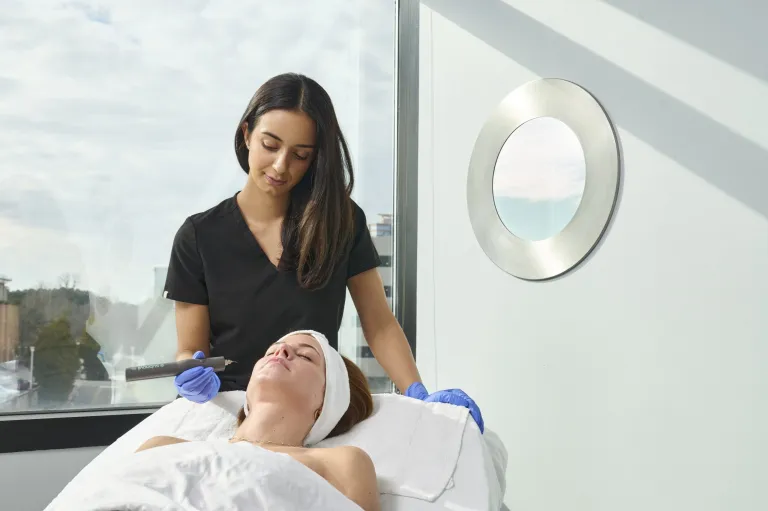
These three treatments all stimulate collagen. They all involve some degree of controlled skin injury. And they all show up in the same search results when you type “skin tightening near me.” But plasma pen, standard microneedling, and RF microneedling work through different mechanisms, target different depths, and solve different problems. Choosing between them is not about which one is “best” — it is about which one matches your specific concern. Here is how we help patients at ELLEMES Medical Spa in Sandy Springs make that decision.
How Each Treatment Works
Plasma pen: SubNovii creates an ionized electrical arc from an electrode held above the skin to the tissue. The electrode does not touch the skin, but the energy injures it. Its K201738 clearance is for skin-lesion removal/destruction and tissue coagulation, not a blanket cosmetic tightening or eyelid-lift indication.
Microneedling: A device with fine sterile needles creates hundreds of tiny puncture channels in the skin. The depth is adjustable, typically ranging from 0.5mm to 2.5mm depending on the treatment area and concern. These micro-channels trigger the wound-healing cascade — inflammation, proliferation, and remodeling — which produces new collagen over the following weeks. Microneedling does not generate heat and does not contract tissue. Its primary strength is improving skin texture, tone, and surface-level scarring through collagen induction.
RF Microneedling (Vivace): Combines the mechanical micro-channels of microneedling with radiofrequency energy delivered through the needle tips directly into the dermis. The RF energy heats the deeper tissue layers, causing thermal coagulation that stimulates a more robust collagen and elastin response than needles alone. Vivace RF Microneedling works at a deeper level than standard microneedling and adds a mild tightening component from the thermal energy — though the tightening mechanism is different from plasma pen’s surface contraction.
What Each Treatment Does Best
This is where the comparison becomes practical. Each treatment has a sweet spot — the concern it addresses more effectively than the other two.
Plasma pen may be discussed for selected cosmetic concerns after assessment, but it is not established as the uniquely effective non-surgical option for loose skin. Expected benefit, evidence, healing, and the risk of pigment changes or scarring should be compared with alternatives.
Microneedling is strongest for: Texture, tone, and superficial scarring. Acne scars, enlarged pores, uneven skin texture, mild hyperpigmentation, and overall skin quality improvement. Microneedling excels at resurfacing — creating smoother, more refined skin — without significant downtime. It is also the most versatile of the three in terms of skin type compatibility, with lower risk of hyperpigmentation in darker skin tones compared to plasma pen. For patients dealing with acne scarring, microneedling is typically the first-line recommendation.
RF microneedling is strongest for: Deeper collagen remodeling, mild-to-moderate skin laxity, and concerns that involve both texture and firmness. The radiofrequency component reaches the deeper dermis where standard microneedling needles alone have less impact. Vivace is particularly effective for patients who want tightening and texture improvement in the same session — lower face firming, neck laxity, crepey chest skin, and overall facial rejuvenation where the skin is not dramatically loose but has lost its firmness.
Downtime Comparison
Downtime is often the deciding factor for patients who are choosing between these treatments, and the differences are significant.
Plasma pen: 7 to 10 days of visible downtime. Carbon crusts form over the treatment area and shed between days 5 and 10. Swelling peaks on days 2 to 3, especially around the eyes. The treated area is cosmetically obvious during this period — you cannot cover the crusts with makeup. Most patients plan around this recovery window and take time off from social or professional commitments. For a full breakdown, see our plasma pen aftercare guide.
Microneedling: redness and swelling may settle relatively quickly, but crusting, bleeding, pigment changes, infection, and prolonged effects are possible. The FDA lists crusting among known risks; makeup timing should follow the provider’s instructions and healing.
RF microneedling adds thermal injury to needle treatment, so recovery and risk are not identical to standard microneedling. The FDA reported serious complications with certain RF microneedling uses in October 2025, including burns, scarring, fat loss, disfigurement, and nerve damage. These reports do not predict an individual patient’s risk, but the possibility of lasting injury belongs in the treatment discussion.
How Many Sessions Each Requires
The treatment cadence differs meaningfully across the three, and this affects both your time commitment and total cost over a treatment course.
Plasma pen: session number, interval, and maintenance should depend on assessment and recovery. A one-to-three-year duration is not established by the SubNovii clearance and should not be guaranteed. Discuss the expected duration and limits before choosing treatment.
Microneedling: 3 to 6 sessions spaced 4 to 6 weeks apart for most concerns. Texture and pore refinement may be noticeable after 2 to 3 sessions. Acne scarring typically requires the full series. Maintenance sessions every 3 to 6 months sustain the improvement. The per-session downtime is minimal, but the total number of sessions is the highest of the three.
RF microneedling: a clinician may propose a series, but there is no universal proof that RF needs fewer sessions than standard microneedling for every concern. Discuss the exact indication, response, and risk before additional treatment.
Cost Comparison at ELLEMES
Comparing sticker prices per session does not tell the full story — total cost over a treatment course and the duration of results both matter.
Plasma pen pricing starts at $400 for small areas and $600 for eyelid or submental treatment under the clinic’s listed examples. A one-to-three-year result cannot be promised from that purchase. Confirm the number of recommended sessions and the total quote; see full pricing on our Plasma Pen service page.
Microneedling: A series of 4 to 6 sessions plus maintenance adds up over time, but the per-session cost is lower than plasma pen and the downtime per visit is minimal. Microneedling is the most accessible entry point for patients new to collagen-stimulating treatments. Visit our microneedling page for current pricing.
RF microneedling: Higher per-session cost than standard microneedling, but fewer sessions needed and longer intervals between maintenance. For patients who want both texture improvement and mild tightening, the per-result value can be strong. See Vivace RF Microneedling pricing for details.
Skin Type Considerations
This is a critical differentiator that does not get enough attention in most comparison articles.
Plasma pen: Best suited for Fitzpatrick skin types I through III (fair to medium). Types IV through VI carry a significantly elevated risk of post-inflammatory hyperpigmentation due to the thermal energy applied at the skin surface. Many experienced providers — including ours — will recommend an alternative for patients with darker skin tones rather than proceed with plasma pen. Our plasma pen side effects post covers this in detail.
Microneedling: Safe across all Fitzpatrick skin types when performed at appropriate depths. Because microneedling does not generate heat, the risk of hyperpigmentation is lower than with thermal treatments. This makes it the most broadly accessible option of the three, particularly for patients with hyperpigmentation concerns or melanin-rich skin.
RF microneedling: pigment injury remains possible. VIVACE K193070 specifies its facial-wrinkle use for Fitzpatrick I–V at 1 MHz, rather than all skin types or all settings. Ask which exact model and indication are proposed and how your individual risk will be assessed.
When to Combine Treatments
These three treatments are not mutually exclusive. Because they work at different depths and through different mechanisms, combining them can address multiple concerns more effectively than any single treatment alone.
Plasma pen plus RF microneedling: combining tissue injuries is not automatically more effective or safer. The providers should assess the indication, complete healing, cumulative risk, and whether a second procedure is justified.
Plasma pen plus standard microneedling: After plasma pen has tightened and contracted the skin, microneedling sessions can refine texture and smooth any residual surface irregularity. This pairing works well for patients treating eyelids or lip lines with plasma pen who also want overall facial skin quality improvement.
RF plus standard microneedling: do not automatically alternate procedures between visits. A clinician should decide whether another injury is appropriate and allow recovery rather than following a generic maintenance sequence.
HydraFacial or other maintenance treatments should be coordinated with the treating providers after adequate healing. Working at a different depth does not prove that a procedure cannot interfere with recovery.
How to Decide
The decision framework is simpler than the comparison might suggest. Start with your primary concern.
For loose skin, discuss the cause, degree of laxity, skin type, and whether a non-surgical procedure can reasonably meet your goals. Plasma pen should not be presented as producing a result that all other non-surgical options cannot match.
For texture or scars, microneedling may be one option. Its suitability and likely benefit depend on the scar type and patient; neither improvement nor an absence of pigment complications is guaranteed.
If your concern is somewhere in between — you want firming and tightening but also texture improvement, and you would prefer moderate downtime rather than a full week of recovery — Vivace RF Microneedling occupies the middle ground. It is more aggressive than standard microneedling but less intensive than plasma pen, and it addresses both the texture and firmness layers.
If you are not sure which category your concern falls into, that is exactly what a consultation is for. Your provider will evaluate your skin, identify what is actually driving the issue — laxity, texture, volume, or some combination — and recommend the treatment or combination that targets it most effectively. View all skin tightening options at ELLEMES.
Learn more about Plasma Pen at ELLEMES Medical Spa →
Book a complimentary consultation →
ELLEMES Medical Spa is located at 5505 Peachtree Dunwoody Road in Sandy Springs, GA — serving patients from Buckhead, Brookhaven, Dunwoody, and greater Atlanta.
Sources for the clinical information: FDA microneedling device guidance; SubNovii FDA clearance K201738; FDA RF microneedling safety communication, October 2025; VIVACE FDA clearance K193070.