
VI Peel Side Effects and Risks: What to Know Before Your First Treatment
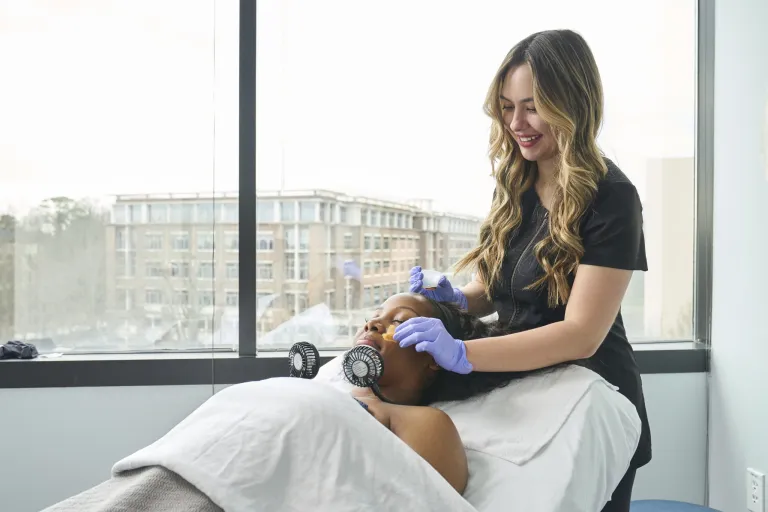
Tightness, peeling, and temporary color changes can occur after a VI Peel. This guide distinguishes a usual recovery pattern from symptoms that deserve attention, explains screening, and helps you prepare for aftercare.
Common Effects During Recovery
The type and intensity of the response vary. The day ranges below are approximate; a worsening symptom deserves attention even within an expected recovery window.
Tightness and dryness: these are common early effects as the treated surface begins to shed. Use the recommended products and report marked discomfort or cracking.
Temporary darkening: treated skin can look darker before peeling. Persistent or increasing dark patches should be reviewed, especially after the peeling has finished.
Peeling and flaking: the manufacturer describes peeling starting around day three and often continuing for another three or four days. Some people shed less visibly or take longer.
Pinkness: mild redness can accompany healing. Contact your provider if it worsens, is painful, or occurs with warmth, swelling, or discharge.
Actual Side Effects: Uncommon but Possible
These go beyond the expected peeling process. They are not typical, but they do happen — and knowing what to watch for matters.
Prolonged redness: redness can persist longer than expected. Ask your provider to assess it, particularly when accompanied by pain, warmth, or swelling; there is no need to wait three weeks to report a concern.
Post-inflammatory hyperpigmentation: inflammation can leave darker patches, particularly in pigment-prone skin. Careful selection and aftercare help reduce risk, but a reaction can occur despite appropriate treatment and good adherence.
Breakouts can occur after a peel, but new lesions should not automatically be dismissed as “purging.” Ask the provider to assess painful, persistent, or worsening breakouts.
Flaking beyond day seven: recovery can take longer, especially after a first peel. Keep to the recommended products and check with your provider if the skin remains sore, cracked, or increasingly irritated.
Swelling: some puffiness can occur. Significant, rapidly increasing, painful, or eye-area swelling should be assessed promptly rather than waiting for a fixed time limit.
Rare but Serious Complications
These are uncommon with a properly administered VI Peel, but they exist in the clinical literature for medium-depth chemical peels and should be acknowledged.
Scarring: this is a possible complication of chemical peels. Picking and irritating products can increase risk, but scarring should not be attributed almost entirely to patient aftercare. The AAD describes peel risks and recovery precautions.
Infection: altered skin barriers can become infected. Keep the area clean as directed and contact your provider promptly for spreading redness, increasing warmth, pus, or worsening pain.
Allergy: disclose previous reactions and all known ingredient allergies. The exact formulation matters. A patch test is not a reason to proceed with a product to which you have a known allergy.
Who Should Not Get a VI Peel
VI Peel may be used across a range of skin tones after screening. Skin tone alone does not determine suitability; health conditions, medicines, allergies, and active skin problems also matter.
Pregnancy or breastfeeding: these are contraindications in VI Peel’s manufacturer guidance. HydraFacial’s instructions also exclude pregnancy and breastfeeding. Discuss alternatives with your obstetric clinician; our pregnancy skincare information can help prepare questions.
Cold sores or herpes history: tell your provider before booking. VI Peel’s contraindication guidance includes herpes history, and a clinician must assess your situation. Taking an antiviral does not automatically establish eligibility.
Active skin infections or open wounds: Any active bacterial or fungal infection in the treatment area, or any open cuts, abrasions, or wounds, must be fully healed before a peel is applied. Applying acid to compromised skin dramatically increases the risk of scarring and infection.
Isotretinoin: VI Peel’s manufacturer excludes use within the previous six months. Tell your provider the medicine and dates. Decisions about other procedures are product-specific and should be coordinated with the prescribing clinician.
Active eczema, psoriasis, or dermatitis in the treatment area: These conditions compromise the skin barrier. Applying a chemical peel on top of an active flare will worsen the condition and increase the risk of complications. Wait until the area is clear and stable.
How to Minimize Side Effect Risk
Good preparation and aftercare lower some risks, while individual reactions remain possible. Reporting a problem early helps the clinic respond appropriately.
Follow the take-home kit schedule for the exact formulation. Towelettes are used at specified early intervals; they are not a daily seven-day step. Ask before substituting other products.
Leave peeling skin attached until it sheds naturally. Picking or rubbing can injure healing skin and increase the risk of pigment changes, infection, and scarring.
Use the kit’s sun-protection instructions after the initial no-product window, and avoid direct exposure while healing. Continue broad-spectrum SPF 30 or higher afterward.
Avoid retinoids, AHAs, BHAs, and vitamin C for at least 7 days post-peel. These are active ingredients that further exfoliate or stimulate the skin. Layering them on top of a peel is too much. Wait until peeling is fully complete and your provider clears you to resume.
Plan for a break from workouts and heat. VI Peel’s exercise guidance advises 72–96 hours without exercise and the full peeling week for those prone to PIH or melasma. Confirm your own return-to-activity plan.
VI Peel vs. Other Peels: Is It Safer?
Comparing peel risks requires the exact product, depth, and patient history. A brand name alone cannot establish which treatment is safest for you.
Superficial peels generally have shorter recovery than deeper procedures, though irritation and pigment changes remain possible. The formulation and your skin’s response still matter.
Deep peels involve more extensive injury, medical supervision, and longer recovery. They can cause persistent color changes and scarring. Medium-depth peels also carry these complications, even though the risk profile differs.
Formulation, peel depth, the clinician’s assessment, and aftercare all influence risk. Ask about the exact product and how your medical and skin history affect the choice, rather than relying on a brand-wide safety comparison.
When to Call Your Provider
Most patients complete their VI Peel recovery without any issues. But contact our Buckhead-area office if you experience any of the following:
Increasing redness, swelling, warmth, or pain at any stage should be reported promptly, particularly if symptoms are spreading or you feel unwell.
Pus, crusting, or oozing from any area of the treatment zone — this is not part of normal peeling and may indicate infection.
New or progressively darkening patches after peeling should be assessed. Pigment changes have different causes, and the treatment should follow that assessment.
Blistering — blisters are not a normal part of VI Peel recovery. If blisters appear, do not pop them. Contact your provider for assessment.
Limited visible peeling can occur. Ask your provider about your response and follow-up; lack of peeling alone does not establish a failed treatment or a need for greater strength.
Knowing the usual course, following your kit instructions, and having a clear contact plan can make recovery easier to manage. Seek assessment for unexpected or worsening symptoms.
Learn more about VI Peels at ELLEMES Medical Spa →
Book a complimentary consultation →
ELLEMES Medical Spa is located at 5505 Peachtree Dunwoody Road in Sandy Springs, GA — serving patients from Buckhead, Brookhaven, Dunwoody, and greater Atlanta.