
Is RF Microneedling Worth the Cost? What You're Actually Paying For
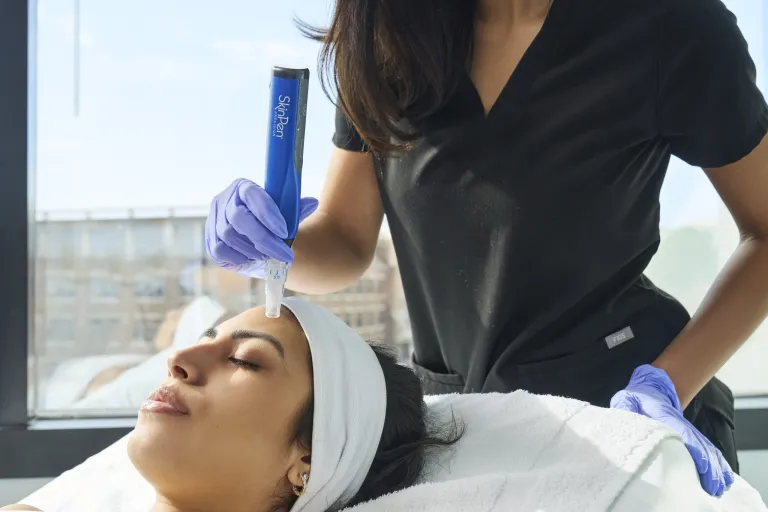
RF microneedling costs more than a standard facial, more than most chemical peels, and more than traditional microneedling. A single session at a reputable clinic in the Atlanta area typically runs $750 to $1,350 depending on treatment area, and a full series of 3–4 sessions puts the total investment between $2,250 and $5,400. That is a meaningful amount of money, and the question of whether it is worth it deserves a more honest answer than “you are investing in yourself.”
Here is a straightforward breakdown of what drives the RF microneedling cost, how it compares to alternatives that treat the same concerns, and — just as importantly — when it is not the right investment for your situation.
What You Are Paying For in Each Session
The price of a Vivace RF Microneedling session at ELLEMES reflects several components that are not always obvious from the outside.
The device itself: RF microneedling systems like Vivace are capital equipment purchases that cost clinics significantly more than standard microneedling pens. The technology — a robotic motor, insulated gold-tipped needles, calibrated RF energy delivery — is more sophisticated and more expensive to acquire and maintain. Single-use needle cartridges add a per-treatment consumable cost that standard microneedling devices do not carry at the same level.
Provider time and expertise: A Vivace session takes 60–90 minutes including numbing, treatment, and post-care. The provider adjusts needle depth and RF intensity across different facial zones based on tissue thickness, skin concern, and your individual response. This is not a one-setting procedure applied uniformly — it requires clinical judgment at every pass. That expertise has a cost.
Numbing and post-treatment products: ask what will be used, why it is appropriate, and whether you have relevant allergies. “Medical-grade” is not evidence that a product is approved for delivery through microneedling channels; FDA device clearance does not cover such product combinations.
Safety processes: reusable equipment must be cleaned as its instructions require, and sterile single-use needle cartridges must not be reused. Ask about provider qualifications, medical oversight, and the clinic’s process rather than assuming every business has identical safeguards.
ELLEMES Pricing and Package Options
At ELLEMES Medical Spa in Sandy Springs, Vivace RF Microneedling is priced as follows: $800 per session for face only, $1,050 for face and neck, and $1,350 for face, neck, and chest. Multi-session packages reduce the per-session cost — a package of 3 saves 10%, and a package of 5 saves 15%.
At the listed face-and-neck price, a three-session package with a 10% discount totals $2,835 before any applicable charges. Clinical benefit and duration vary; that purchase does not guarantee twelve-to-eighteen-month results or make maintenance mandatory.
We publish pricing on our service page because we think patients should be able to evaluate cost before scheduling a consultation. If a treatment does not fit your budget, knowing that upfront saves everyone’s time.
How RF Microneedling Compares to Alternatives
The value question is clearer when you compare RF microneedling to other treatments that address the same concerns — skin laxity, fine lines, acne scars, texture, and pore size — rather than evaluating it in isolation.
Standard microneedling typically costs $250–$450 per session and is effective for improving texture, mild scarring, and surface-level collagen stimulation. It does not deliver RF energy, so it does not produce the same degree of skin tightening or deep scar remodeling. For patients whose concerns are limited to surface texture and tone, standard microneedling is a legitimate and more affordable option. For patients who need measurable tightening or deeper structural remodeling, the additional cost of RF is paying for a mechanism that standard needles alone cannot achieve.
Chemical peels vary substantially in depth, mechanism, recovery, and risk. Medium and deep peels should not be described as affecting only the surface. Ask which exact peel or RF procedure fits the concern and whether combining them is appropriate.
Ablative laser resurfacing (CO2, Erbium) is the most aggressive non-surgical option for skin quality, typically costing $2,000–$5,000 for a single session. It produces more dramatic results in fewer sessions but comes with 7–14 days of significant downtime, higher risk of complications, and is not safe for all skin tones. For patients who can tolerate the recovery, ablative lasers may deliver more per session — but the extended downtime, discomfort, and risk profile make RF microneedling the practical choice for most patients balancing results with real-world schedules.
Non-ablative lasers like MOXI cost $400–$800 per session and treat superficial tone, texture, and early sun damage with 1–3 days of downtime. MOXI does not tighten skin in the way RF microneedling does. The two treatments address different depths — MOXI for the superficial dermis and Vivace for deeper structural collagen — and work well as a combination approach.
Surgical facelift costs $8,000–$15,000 or more and delivers the most definitive tightening result. It also requires general anesthesia, weeks of recovery, and carries surgical risks. RF microneedling is not a substitute for a facelift in cases of significant laxity — but for patients with mild to moderate laxity who are not ready for or do not need surgery, a Vivace series provides meaningful improvement at a fraction of the cost and recovery.
The Per-Year Math
One way to evaluate whether RF microneedling is worth the cost is to look at it on an annualized basis rather than as a lump sum.
A typical treatment plan for a patient addressing moderate skin laxity and texture: 3 sessions in year one (initial series), then 1–2 maintenance sessions per year going forward. At the face-and-neck rate with a 3-session package, year one costs approximately $2,835. Subsequent years cost $1,050–$2,100 depending on whether you do one or two maintenance treatments.
Spread across 12 months, the ongoing maintenance cost is roughly $88–$175 per month — comparable to what many patients already spend on medical-grade skincare products, and less than a single unit of dermal filler. Whether that monthly equivalent feels worthwhile depends on the results you are getting, which brings us to the more important question.
When RF Microneedling Is Worth It
RF microneedling delivers the best return on investment for patients in specific situations.
Early to moderate skin laxity: Patients in their late 30s through 50s who are noticing jawline softening, loss of firmness, or crepey texture on the neck and chest tend to see the most satisfying results relative to cost. The collagen stimulation meaningfully improves skin structure at a stage where the degradation is still addressable without surgery.
Acne scars requiring dermal remodeling: Pitted and rolling acne scars involve structural collagen loss below the surface. RF microneedling reaches those depths and rebuilds tissue in a way that topical products and surface treatments cannot. For patients who have tried peels, standard microneedling, and medical-grade skincare without sufficient improvement, RF microneedling addresses the problem at the tissue layer where it actually exists. Our acne scar treatment page covers the full range of approaches we use.
Recovery and risk belong in the cost comparison. Many patients have a relatively short visible recovery, but it cannot be guaranteed. The FDA reported serious complications with certain RF microneedling uses in October 2025, including burns, scarring, fat loss, disfigurement, and nerve damage. These reports do not predict an individual patient’s risk, but the possibility of lasting injury belongs in the treatment discussion.
When RF Microneedling Is Not Worth It
There are situations where spending money on RF microneedling is not the best use of your budget, and a responsible provider should tell you this.
If the main concern is pigmentation, first establish its cause. Melasma, sun spots, and redness need different plans; BBL, MOXI, or a peel is not automatically appropriate for each. Irritation or heat can worsen some pigment disorders, so device selection and skin type matter. Ask which, if any, BBL Photofacial, MOXI laser, or chemical peels option fits the diagnosis.
If your laxity is beyond what non-surgical treatments can correct. Significant jowling, neck banding, or heavy skin descent requires surgical intervention. RF microneedling can produce meaningful improvement in mild to moderate cases, but it has a ceiling. Investing in a full Vivace series when a consultation with a plastic surgeon is the more appropriate next step wastes both money and time. Your provider should be direct about this boundary.
If you will not complete the series or follow aftercare. A single RF microneedling session produces visible improvement, but the cumulative results that justify the cost come from completing 3–4 sessions with proper spacing and sun protection between them. If your schedule, budget, or commitment level means you will likely do one session and stop, the per-session cost is harder to justify compared to a single HydraFacial or peel that delivers a complete result in one visit.
At-home RF microneedling is not an alternative recommended here. The FDA says RF microneedling is a medical procedure and these devices should not be used at home. A non-needle home skincare device is a different category and should not be compared as equivalent treatment.
Questions to Ask Before Committing
Before investing in a series, a good consultation should answer these questions clearly. If the provider cannot or will not answer them, that tells you something.
Is RF microneedling the right treatment for my specific concern, or would something else work better? A provider who recommends their most expensive service for every patient is not making clinical decisions — they are making financial ones.
How many sessions will I realistically need? The answer should reference your skin condition specifically, not just repeat “3–4 sessions” without context.
What results should I expect, and what will this treatment not do for me? If the answer includes only benefits and no limitations, that is a red flag.
What does the total cost look like, including the full series and maintenance? At ELLEMES, we walk through the full cost picture during consultation — not just the per-session number.
Learn more about Vivace RF Microneedling at ELLEMES Medical Spa →
Book a complimentary consultation →
ELLEMES Medical Spa is located at 5505 Peachtree Dunwoody Road in Sandy Springs, GA — serving patients from Buckhead, Brookhaven, Dunwoody, and greater Atlanta.
Sources for the clinical information: AAD chemical peel FAQs; AAD melasma diagnosis and treatment; FDA microneedling device guidance; FDA RF microneedling safety communication, October 2025.