
MOXI Laser for Dark Skin Tones: What Makes It Safe and What to Expect
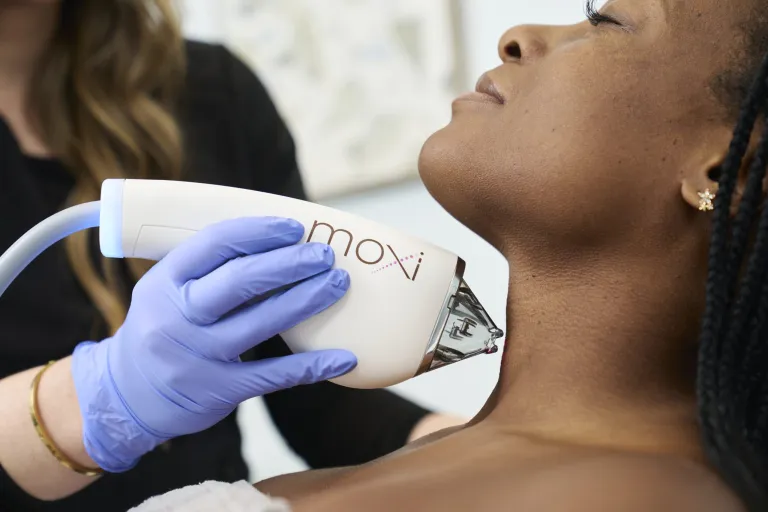
Patients with medium to deep skin tones — Fitzpatrick IV through VI — are routinely told that laser treatment isn’t right for them, or that their options are limited, or that they should stick to topicals. Sometimes that’s accurate. Many laser modalities genuinely do carry meaningful risk of post-inflammatory hyperpigmentation, permanent pigment loss, or scarring in darker skin tones — and those risks are not hypothetical. But the categorical dismissal of laser treatment for darker skin has also left a significant gap in care for patients who have real, treatable concerns that lasers address well. MOXI is one of the treatments that belongs in the “appropriate for darker skin” column when performed by a provider with genuine experience across the full Fitzpatrick spectrum. If you’re researching laser treatment in Atlanta and have been told lasers aren’t for your skin tone, this post explains what the actual picture looks like.
Why Laser Treatment Is Genuinely Riskier for Darker Skin — and Why That Doesn’t Mean Off-Limits
The risk differential for laser treatment in darker skin tones is real and worth understanding clearly. Melanin — the pigment that gives skin its color — is produced by melanocytes distributed throughout the skin. In patients with deeper skin tones, there is more melanin present, and those melanocytes are more reactive. Many laser wavelengths are absorbed by melanin as a chromophore, meaning they target pigment directly. In darker skin, that means the laser energy is absorbed not just by the intended target — a brown spot, for example — but also by the surrounding melanin in the normal skin, generating more heat in the tissue than in lighter skin treated at the same settings.
Pigment complications can occur in darker skin, including after appropriately selected treatment. Device choice, settings, recent tanning, the underlying condition, and the provider’s experience all affect risk; a complication does not automatically prove operator error.
MOXI uses a 1927 nm fractionated non-ablative diode laser, according to Sciton, with water as its target chromophore. Water targeting differs from directly targeting melanin, but thermal injury can still cause pigment changes. Sciton markets MOXI for all skin types; that should not be read as a guarantee for every setting, diagnosis, or patient.
What MOXI Can Treat in Darker Skin Tones
Post-inflammatory hyperpigmentation (PIH): PIH is one of the most common skin concerns among patients with Fitzpatrick IV through VI skin, and one of the most undertreated — in part because many providers are reluctant to use energy-based devices in this population. MOXI’s cell turnover mechanism accelerates the shedding of pigment-laden cells and stimulates collagen renewal in the dermis, which can meaningfully reduce the appearance of PIH from acne, injury, or other inflammatory triggers. Treatment needs to be approached conservatively, with appropriate settings and adequate spacing between sessions, but the results for PIH in darker skin tones are achievable and clinically meaningful. For patients also dealing with active acne that continues to generate new PIH, addressing the acne simultaneously is important — see our acne treatment page for options.
Uneven skin tone and texture: Darker skin tones are not immune to the dullness, uneven texture, and tone irregularity that accumulate with age and sun exposure — they simply manifest differently than in lighter skin. MOXI’s dermal remodeling mechanism addresses these concerns across all skin tones by stimulating collagen production and accelerating cell renewal. The result over a series of sessions is a more even, clearer skin surface with improved texture and tone consistency.
Early photoaging: UV damage accumulates in all skin types, including darker tones where melanin provides some natural photoprotection but does not eliminate the structural effects of chronic sun exposure. Fine lines, early collagen loss, and textural changes from photoaging are all within MOXI’s treatment scope regardless of skin tone. The approach is the same as for lighter skin; the parameters differ.
Melasma needs its own treatment plan. Sun protection and appropriate topical treatment are central, and a laser may be considered for selected patients. MOXI can still aggravate pigmentation; its mechanism does not remove the possibility of a melasma flare. Our MOXI for melasma guide discusses that distinction.
A comparison with IPL or BBL must account for the exact device, filter, settings, skin tone, and diagnosis. MOXI is not automatically a safer route to the same outcome for every patient.
What Darker Skin Patients Should Know About How Protocol Differs
Candidacy in darker skin does not mean risk-free treatment. The provider should assess your skin, pigment history, recent sun exposure, and the proposed settings before deciding whether to proceed.
A conservative plan may be appropriate, but lighter settings or more visits do not guarantee the same eventual result. Response and tolerability should guide whether another session is justified.
More sessions may be required: Because individual session intensity is lower for darker skin, more sessions may be needed to achieve a comparable cumulative outcome to what a lighter-skinned patient achieves in a shorter series. This is worth establishing clearly at consultation rather than discovering after a two-session series produces less improvement than expected. A realistic protocol for a Fitzpatrick V or VI patient treating established PIH or uneven tone might involve four to five sessions rather than three, with conservative spacing and careful assessment after each one.
Longer intervals between sessions: Some providers extend the spacing between sessions for deeper skin tones — six to eight weeks rather than four to six — to ensure the skin has fully recovered from each treatment before the next thermal stimulus is introduced. This reduces the cumulative risk of triggering a melanocyte response across repeated sessions. Your provider will assess your skin’s healing response after each session and adjust the interval accordingly.
Use broad-spectrum, water-resistant SPF 30 or higher and protective clothing and shade. For melasma, the AAD recommends tinted sunscreen containing iron oxide to help protect against visible light. Choose a product you can use consistently; mineral versus chemical filters alone do not determine suitability.
Topical preparation before treatment: Many experienced providers recommend a course of topical depigmenting agents — prescription-strength hydroquinone, tranexamic acid, azelaic acid, or medical-grade brightening formulations — in the weeks before beginning a laser series for darker skin patients. Pre-treating with a depigmenting agent reduces baseline melanocyte activity and may decrease the risk of a post-treatment pigmentation response. Your provider can advise on whether pre-treatment topical preparation is indicated for your skin specifically.
Lasers and Devices That Are Generally Not Appropriate for Darker Skin
Part of being a well-informed patient is understanding what to avoid, not just what to pursue. Several commonly offered treatments carry significantly elevated risk for Fitzpatrick IV through VI patients and are worth being aware of when evaluating your options.
Ablative lasers (CO2, Erbium): Ablative lasers remove the skin surface entirely and generate significant thermal injury. In darker skin tones, the risk of post-inflammatory hyperpigmentation, hypopigmentation, and scarring is substantially elevated. These are not appropriate first-line options for the vast majority of darker skin patients and require extreme caution and significant expertise even when used conservatively.
IPL and BBL require particular care when epidermal pigment may absorb treatment energy. Skin type, the exact device and filter, and the indication matter; the BBL brand does not make all light treatments interchangeable or automatically suitable. See MOXI vs. BBL for their different treatment targets.
Q-switched and picosecond lasers: These devices are sometimes offered for pigmentation correction in darker skin, and in experienced hands with appropriate settings they can be used. However, the risk of rebound hyperpigmentation and paradoxical darkening in Fitzpatrick IV through VI skin is well documented, and the margin for error is narrow. These are not devices to seek out from a provider who does not regularly treat your skin type.
The common thread across all of these is not that they can never be used in darker skin — it is that they require a provider who genuinely understands the risk profile, has the device expertise to adjust parameters appropriately, and has experience reading and responding to how darker skin tones heal. A provider who primarily treats lighter skin patients and occasionally sees a patient with a deeper skin tone is not the same as one whose practice regularly includes the full Fitzpatrick range. That distinction is worth asking about directly when evaluating where to have treatment.
Complementary Treatments That Work Well Alongside MOXI for Darker Skin
Chemical peels: Superficial to medium-depth chemical peels — particularly those formulated for melanin-rich skin — can safely accelerate cell turnover between MOXI sessions and help maintain the tone improvement from each laser treatment. Peel selection and depth matters; aggressive peeling in darker skin carries its own PIH risk, and treatment should be sequenced with provider guidance rather than self-directed.
Cosmelan and other pigment-treatment options can be discussed after diagnosis. A branded peel should not be ranked as more clinically effective than every alternative without evidence for the particular comparison. Recovery and the risk of irritation also matter.
Microneedling: Microneedling uses mechanical micro-injury rather than heat or light, which makes it a lower-risk collagen stimulation option for darker skin tones compared to energy-based devices. It is well-tolerated across the full Fitzpatrick spectrum when performed at appropriate depths. Alternating microneedling and MOXI sessions — rather than performing both simultaneously — provides continuous collagen stimulation through two different pathways while giving the skin adequate recovery time between treatments.
Topical treatment should be chosen for the diagnosed concern, not prescribed automatically because a patient has darker skin. Prescription agents need an individualized plan, including how to avoid irritation and when to restart them after treatment.
Questions to Ask Before Booking Any Laser Treatment as a Darker-Skinned Patient
How often does the provider treat Fitzpatrick IV through VI patients? A provider who sees patients across the full skin tone spectrum regularly makes meaningfully different parameter decisions than one who does so occasionally. Ask directly — it is a reasonable clinical question, not an awkward one.
What is their protocol for darker skin specifically? Conservative settings, extended spacing, topical preparation — a provider with genuine experience should be able to articulate how their approach differs for deeper skin tones rather than offering a generic answer about safety.
What happens if post-inflammatory hyperpigmentation occurs? A provider who has treated darker skin extensively has a plan for managing PIH if it develops. One who doesn’t have a clear answer to this question is worth reconsidering.
Ask about the provider’s experience with your skin tone and the exact proposed procedure. A clinic’s equipment list alone cannot establish its competence or your candidacy.
At ELLEMES, our providers treat patients across the full Fitzpatrick spectrum and adjust protocols based on individual skin assessment rather than applying a one-size approach. The MOXI service page covers pricing, session options, and what to expect at your first appointment. For patients with specific pigmentation concerns — melasma, PIH, uneven tone — a consultation is the right starting point before committing to any treatment plan.
Learn more about MOXI Laser at ELLEMES Medical Spa →
Book a complimentary consultation →
ELLEMES Medical Spa is located at 5505 Peachtree Dunwoody Road in Sandy Springs, GA — serving patients from Buckhead, Brookhaven, Dunwoody, and greater Atlanta.
Sources for the clinical information: AAD melasma diagnosis and treatment; Sciton MOXI information; AAD melasma self-care.